Digital Violin
the symphonic violin - liberated, dignified - Rickenbacker Catalogue, 1936
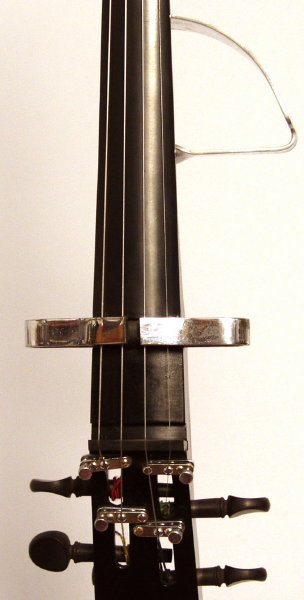
Beauchamp Electro Violins
Possibly, nothing is known of the first experiments by George Beauchamp in making an electric violin. In the work of Beauchamp there is a connection to the work of John Matthais Augustus Stroh, through whom a direct link is made to the development of record and playback devices in the late 19th Century. Undoubtedly then is the connection to Thomas Alva Edison and ultimately Faraday's Laws of Electrical Flux. Electric Violin history and truthfully Violin history maintains strong links with the most eminent figures.
Possibly the connection made between a relatively unknown figure like Beauchamp and the greatest minds of recent times is unlawfully stronger than the following Modern Guitar Magazine gossip.
Beauchamp reportedly visited the UK in the early 1900s intending to see the makers of Stroh violins. He returned after seeing only the instruments but with the idea of attaching a horn to a guitar. The later work of Beauchamp, more obviously the second Electro Violin shows more than just rumoured acquired ideas. However one fact remains and it removes the need for any gossip. Beauchamp did succeed in creating a most radical electric violin. For decades this "first" electric violin has been obscured and hidden. But now it has re-emerged from the mists of time, intact and in full working order. And for a short time on Sale from Musurgia - Fine, Rare and Peculiar Musical Instruments!
- George Beauchamp filed an Patent application for his Electro Violin in January 1936.
- The first production model Beauchamp violin was called the Electro Violin.
A patent application made by Beauchamp in January 1936, for an electrical stringed instrument was granted by the United States Patent Office in September, 1938. This instrument as thoroughly outlined in the accepted full patent specifications is generally considered the first electric violin to be made commercially available. It was manufactured by the Electro String Instrument Corporation - formed from an alliance between Beauchamp and one Adolph Rickenbacker in Los Angeles. This Corporation was set up exclusively to manufacture electric stringed instruments. The catalogue of instruments that Electro produced was illustrated with the words "Brother Musician Listen to a Miracle" but somehow by the mid-1970s the name Electro String Instrument Corporation was associated with only string manufacturing, the mere accessories to the Art of Violin making?
For the difficult period of time considered there are no such thorough, reliable and interesting facts as cheaply available as the Full Patent Specifications. In the case of Beauchamp the reader is bombarded from the outset by what have become incredibly accurate claims but George does it in a grand sweeping manner.
This invention relates to musical instruments and relates more particularly to electrical musical instruments of the violin type. A general object of this invention is to provide a practical, compact and effective electrical stringed musical instrument.
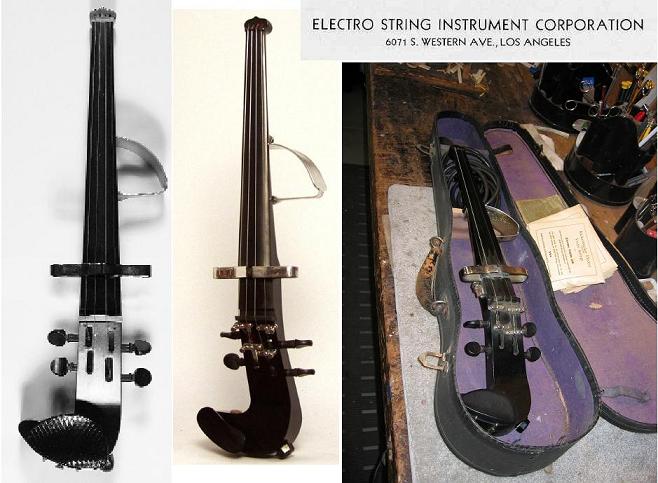
images above from left to right - American Musical Instrument Society Newletter (Vol 29, No.3; Fall 2000); Musurgia: New York String Service, New York (2004); Anon (2006)
One of the many remarkable features of this "practical" design is that it is made of bakelite. There does not seem to be a comparison to Beauchamp. Every detail regarding traditional violin making appears to have been studied, questioned and then altered. Aspects of this electric violin having the all important 'staying-power' to survive 'time' are very much in evidence when considering the musical market of today. Plastics, fibre-glass, carbon-structures, acrylics are beginning to work. In the last two decades of the second millennium one of the most common features of bowed stringed instruments, that of being made from trees, is slightly less common.
The materials used by Beauchamp must have been variable in trial. The main evidence tells of a bakelite violin, something now probably only traceable through specialist auction houses. Bakelite is not only very collectable it is beautiful, changing colour with age and possibly even acquiring a matured sound. No-one can say unless the instruments or at least people who played them still exist. In the full-patent specification Beauchamp records that he found the "best results" came from making the body from a synthetic organic substance. What these results were could well be anyone's guess. A serious point is made in the following, although it does provide lots more research for which I am grateful.
...there's some good photos taken during the 1930's of the NBC Radio Orchestra, which was a really big deal in America, which show a complete electronic orchestra section with Rickenbacker violins, violas, and basses. The conductor has a primitive mixing cabinet by his side where he can presumably mix in (or out) these musicians...
I'm not a violin player but more interested in this instrument from the design engineering aspect. The Bakelite version, especially, seems to look like it came from the future . . . a very advanced study in materials in design. There's the possibility it doesn't sound good, of course, but in fact I've heard that in fact it was not bad sounding. Anyway, I think I'd like to make these again, if only to recapture the history and ambience...
Some years ago an older gentleman, who surely could not still be alive, wrote offering his instrument for sale and included a photograph. At that time I felt a bit funny about making the contact and gave this to a friend to pursue. Unfortunately, he lost the letter and the photo in the move to Scotland, and I still kick him about that every time we visit. I really wish we had one in the collection...
I sure wish I remember that fellow from New Jersey that had one. I just remembered his first name . . . Al . . . so maybe I'll remember his surname in time. He was a member of that radio band that I told you about...
One point that is relatively unknown is that the Rickenbacker "Electro String" Company sued the Meissner folks at one time. Don't know the exact outcome but our patent stood and they died away, so we must have prevailed in some fashion."
John Hall, Chief Executive Officer to Rickenbacker International
A few years after the world's musical market was presented with the Electro Violin Beauchamp's instrument design changed almost completely.
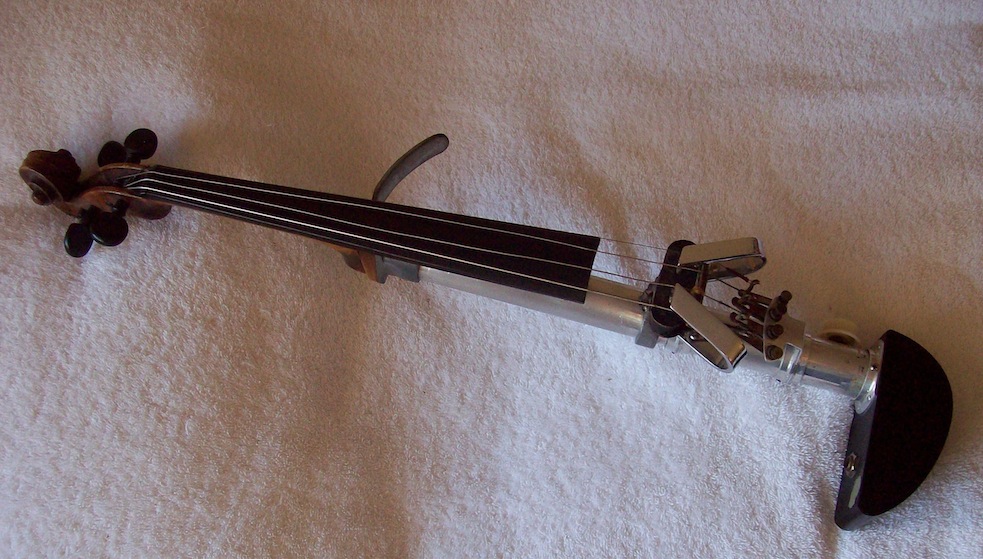
The above played by the Californian violinist, James Campiglia. Two versions are known to exist
The second Electro Violin is made of aluminium and was granted a patent on February 9th, 1943 (number 2`310`199). Both Electro instruments are certainly departures from the traditional instrument in appearance and would more than likely cause some conversation amongst any audience.
Five days after Beauchamp's second violin was granted patent a journalist reported that Beauchamp had invented a skeletal violin.
If you see a musician stand up to play his solo with something that has had the head and neck of a fiddle but lacks the body that has been standard since the days of Stradivarius, it is likely that the instrument is the invention of George D. Beauchamp of Los Angeles, for which he received patent No. 2`310`199. The body is replaced by a tube of metal or plastic, in which are electrical pick-ups that translate the strings' vibration directly into terms of current fluctuations, for broadcasting purposes.
New York Times, Monday February 14, 1943
"Fiddle Without a Body" (sec.III, pg.9 col.2).
An article with the tongue firmly in the cheek and more cartoon like in tone than the shape of things to come. Presumably a more thorough search of newspapers during these years will turn up more tiny scraps of information to add to the whole picture. Who did Beauchamp appeal to? Was he ridiculed, ignored or simply missed because the World was at War?
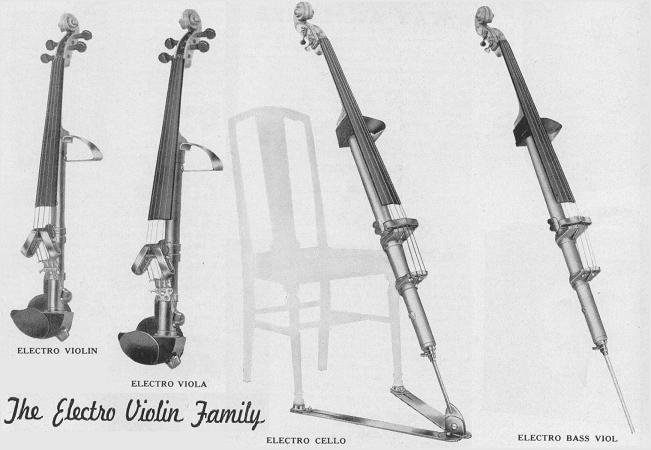
Studying the two designs more closely obvious changes to the whole design beg questions. The first instrument design has no scroll, the pegs are found on the tailpiece side of the bridge, just in front of the player's chin. No longer the yard for a beginner to measure by - how can they wrap their fingers around a scroll that isn't their? The first design almost looks like a hockey stick from above or below and a rifle from the sides
A curiously spurious claim in the full patent specification is that the pick up, which is an electro magnetic, horse-shoe design, is "arranged so that it does not interfere with the playing of the instrument". This is totally untrue. The pick up completely surrounds the strings at one point (near the end of the fingerboard, at the seventh harmonic), making part of each string inaccessible.
In the second design the pick-up device appears more sensibly over the bridge but still masking a portion of each string. This Electro Violin#2, from the drawing given in the USA Patent Specification, appears more like a Stroh-Violin without the big circular diaphragm and bellowing horn. I've seen a detail photo of an Electro Violin#2 with what looks like traditional pegs set in a more familiar looking scroll. Was the object in Beauchamp's mind to make it appear more appealing and/or acceptable to the traditionalists? The main frame beneath the fingerboard looks like it is made out of part of a bicycle or a piece of thin scaffolding. No luck there then !
The tailpiece and chin/shoulder support are literally bolted on; the pick-up device, bridge and tailpiece are moveable along this tube, for "individual comfort and tuning purposes".
The First electric violin?
Beauchamp did not invent the first electric violin. There is a case however that he did manage to manufacture the first commercially available electric violin. There are more names to add to this story that will put Beauchamp's instrument in true perspective. But for now, this is the instrument that has survived. This instrument broke the mould and set the ball rolling. Beuachamp's Electro Violin is the most unusual for the time and still is today. It is also the oldest electric violin to have come up for sale on the general market.
I am certain both instruments would appeal much more today. Not only able to adjust the tension in the string but the relative lengths as well makes the Electro Violin (#2 especially) a well suited musical instrument to explore the whole world of intonations that the violin is a part of.
Visually, Beauchamp's two electric violins are characterised by a stick shaped design. Both have the traditional neck length, stop and optional shoulder-bout. The neck length is the only aspect that does not challenge the tradition of violin making. Quite conclusively then, George Beauchamp caused the violin to step once again into the unknown but this time with only the strings and bow retained. Maybe the buying public and the musical institutions that would ultimately have to approve musical worth of such an instrument exherted to much influence on Beauchamp's thinking. In many ways the second instrument with all the intricacies and capacity for fine-tuning just looks daft, a feebly mutated splicing of a Stroh Violin against a Stradivarius. The gun and stick appearance of Electro Violin#1 against the upheld belief that a violin is an instrument of beauty is difficult to reconcile.
However aesthetically ugly the Electro Violin might be, the theories and solutions were sound enough to form corner-stones for contemporary makers but not yet. Not for at least another two decades and not surprisingly really.
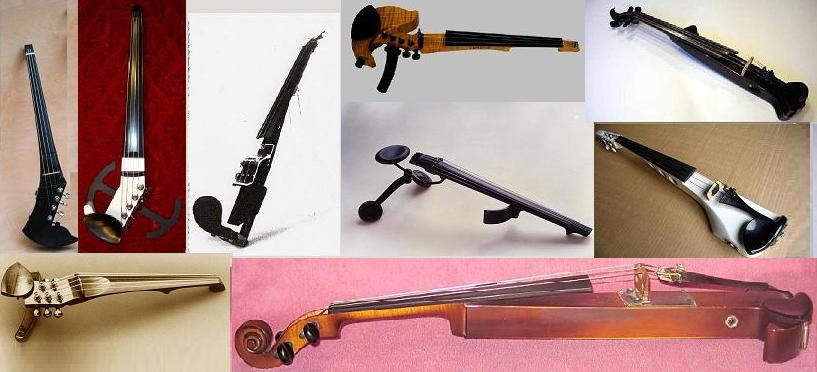
It is almost without doubt that it is Beauchamp's Electro Violin#1 that influences an increasing number of current electric string instrument makers final models. Some of these makers have claimed never to have seen Beauchamp or Stroh violins but reach something very similar. It seems more natural to remove the acoustic chamber of the traditional violin. The electric violin makers of today should know better but they do not in general and who can blame them?
A final twist to the George Beauchamp story is that whatever grievance the player, composer or listener might have had against his violins he was there to reach agreement. Not a vain pandering to whims and fancies of a customer who really has no guidance in electric violin playing but Beauchamp leaving behind him the testament, "if I solved the problem you will not be able to forget me".
This touching conclusion comes from a closer look at the final sentences describing both the Electro Violin#1 & #2, as found in the American Patent Archives.
"Having described only a typical preferred form and application of my invention, I do not wish to be limited or restricted to the specific details herein set forth, but wish to reserve to myself any variations or modifications that may appear to those skilled in the art..."

This work is licensed under a Creative Commons Attribution-NonCommercial-NoDerivs 2.5 License.
up