Digital Violin
updated, as and when
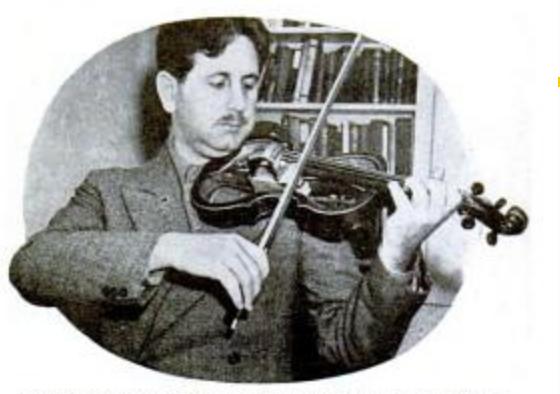
The Benioff Violin
Although there are dangers involved in ruminating on who actually invented the electric violin, discovering all about Hugo Benioff's ideas and inventions is possibly of paramount importance in coming to any conclusions about the origins of electric violin. Hugo Benioff did not live to see his electric violin, electric cello or electric piano reach a manufactured stage and to date there is still no commercially made Benioff musical instrument. There is evidence that Benioff made or had them made and that they were played, by Benioff and others from the musical profession in the area where he lived. There is also compelling fact that directly link Benioff's work with electric violins being manufactured on a fairly large scale today.
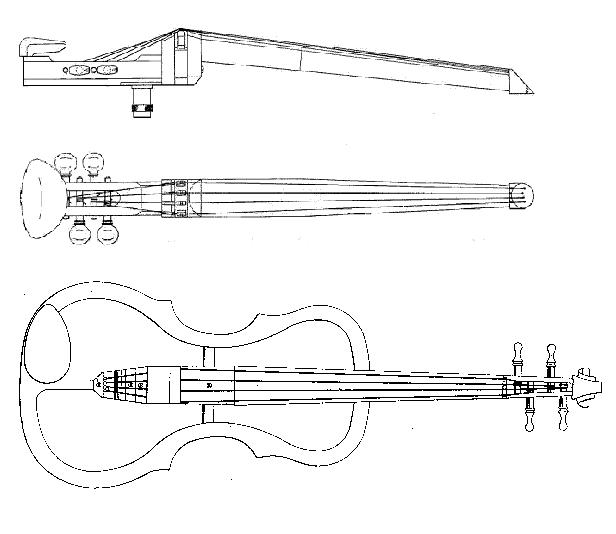
For over seven decades scraps of photographic evidence of a Benioff violin and cello have lain dormant in the back catalogue of the Popular Science Monthly magazine. The first maybe, published in September 1938 and possibly the second in November 1946. The actual instruments though are more worryingly probably lost. The line drawings reproduced here are from the issued patent specifications, with the customary annotations removed; these are essentially the better known images of Benioff's violins. The most crucial question therefore, surrounding Benioff as a musical instrument inventor, developer or maker of any worth is unanswerable. That is of course, until something yet more tangible can be found or replicated.
If you are not a Geologist, Seismographer or Geophysicist you probably do not know of Benioff's work.
.
Hugo Benioff was born in California, September 14th 1899; and for his work and discovery has a phenomena of this planet named after him - the Benioff Zone. The brilliance of his work as a Scientist is documented and not in doubt, though he died aged 69 before any significant interest in his lesser-known musical work was aroused. This may be because he never completed a perfected musical instrument; that his musical work was done in his spare time; or maybe because he was a scientist, the musical establishment and world at large did not notice his work towards an effectively electrified violin.
From his first published papers in the early 1930s, Benioff's name has been synonymous with seismography. He invented a seismometer and strain gauge, both became established in the field. Benioff has helped develop our knowledge and understanding of vibration, right across a large range - from the slow and devastating pulses created by earthquakes to the faster vibrations in music and even to ultra-sonics involved in submarine sound-signalling. It should come as no surprise that someone so interested and gifted in observing, recording and studying vibration is found to have included as part of their output the creation of musical instruments.
As early as 1926, Benioff was investigating and trying to improve vacuum tubes, phase modifiers and oscillators. By 1930, in connection with this work he secured three patents. One, his Phase Modifier (Pat.1,719,356) is of some interest today as it found use in the development of electro graphics or, the use of touch-screen technology. The connection to today is easily followed through the citations made by Hiraki (Pat. 3,865,977) for a system for identifying the position of a stylus (February 11, 1975). Then, from there to Rogers's (Pat. 3,983,322) method and apparatus for converting the location and movement of a manually controlled instrument into corresponding electrical signals (September 28, 1976); to Hoendervoogt's (Pat. 5,107,079) position digitizer circuit for a moveable instrument (April 21, 1992); and finally to Reiger's (Pat. 7,423,480) AC amplifier for precision measurement (September 9, 2008)...
There is no question Benioff succeeded in many ways. His name is honourably attached to work that continues to contribute to the world of science. Just as Stroh and Parsons before him were great engineers who also turned their thinking to violin and musical instrument making, so did Benioff. In this respect he stands apart from nearly all of the other originators of the electric violin. He developed a method of electrifying stringed instruments that is still relevant today and as such is found referenced in records relating to the most current, contemporary and globally commercially successful companies manufacturing pickups and instruments for the complete family of electric violins. Significantly, Yamaha, Fishman and Baggs each cite Benioff's inventions in their granted patent specifications, yet Benioff died before any of these companies had begun work on electrifying violins.
.
Living memory questions whether Benioff actually completed his work. There was no Corporation or Company set up for any of his instruments, musicians were invited to play his instruments in the privacy of his own home. According to press Benioff's electric cello was played in a concert by the cellist Stephen De'ak, possibly meeting Benioff after he joined the University of Southern California in 1943. This may have been the only public performance given using his instruments during Benioff's life-time.
Benioff's musical instruments are at best, known in connection to the Baldwin Piano Company and to the internationally reknowned concert pianist Roselyn Tureck.
In October 1941, Benioff as inventor and assignor to the Baldwin Company filed for an invention for what he called a Piano String Support. A month later he applied for a Transducer for Stringed Musical Instruments invention. Over twenty years later Benioff was still working on his piano inventions in connection with Baldwin and in August 1962 he secured rights for his last invention, an Electro Piano. Four years later, two inventors Daniel Martin and James Ziegler also assigned to the Baldwin Company, filed for an invention (3,470,305) relating to improvements made to Benioff's Electro Piano. Martin and Ziegler were granted this patent a year after Benioff died. In it they use Benioff's term to describe the instrument and make detailed reference to the considerable improvements Benioff achieved in electrifying a piano successfully.
In addition to this tangible support and belief, Roselyn Tureck a brilliant pianist who may have been the only player directly encouraging and helping in Benioff's endeavours spoke of his work in very high regard. Towards the end of her life, when she was living in Oxford she spoke of Benioff as being on the verge of having invented a new instrument and a real progression in piano invention.
The expectation had been that Baldwin would go on to manufacture the Benioff Electro Piano, but the instrument it appears they subsequently made does not carry Benioff's name, and how much of the instrument was true to his ideas is not yet known. It is more unfortunate that Benioff's surviving family have no idea where any of the original musical instruments are nowadays. It is presumed that they form part or parts of an academic collection somewhere.
The violin is a musical instrument that has gradually developed in every way to make best the manner in which the strings vibrate audible; be reliable to hold the tension of these strings; and not to negatively disturb any vibrations demanded by composer and violinist.
In September 1938, Hugo Benioff was reported in the New York Times as being the inventor of the electric violin. Considering the National VioLectric, the Electro String Instrument Corporation, Vivi-Tone and Allencraft had all begun marketing their own brands of electric violin, even if just by a few years this claim of invention appears spurious. However, the article describes how studying seismographs of earthquakes, Benioff was inspired by the gyrations to attach meteorological equipment to musical instruments. From this inspiration came an electric violin, cello and piano. The article gave news of Benioff inviting some of his associates at the California Institute of Technology to a concert given by an all electric orchestra. The success was such that the institute soon planned to establish a center of such research.
The instrument is described in the newspaper article as being similar to the traditional violin but with back and sides missing. The pickup device is described as being a small metal box containing a crystal and working by the piezo effect of vibration registered as an electrical charge. As a description, this bears resemblance to at least one other back and sideless violin from the same period, the Vivi-Tone electric violin by Loar. Lloyd Loar was already known in the musical world and had been a chief engineer at the Gibson Guitar company by the late 1930s.
From the information in the newspaper article Benioff is said to have been inspired to start work in 1930. However, from noting the nature and potential application of his inventions filed in the mid to late 1920s, it is possible that his work towards an electric violin started before the earlier granted patents belonging to Beauchamp, Pfeil and others. Benioff did not start out his work as a musical instrument maker by straight-away claiming the invention of a new violin. In a later article published in the Los Angeles Times reference is made suggesting Benioff may have certainly begun one of his bowed stringed instrument inventions in 1928. He worked the entire system gradually, almost from scratch and his work began with electronics and amplification, leading to the actual instrument. His was not just a new violin body design with a pickup attached, he came around to imagining the whole instrument, including exactly how and why it works. That his invention came nearly ten years after John Compton's attachable pickup device and some eight years after Victor Pfeil's work has potentially disguised the fact that Benioff's work was thorough and toiled over for decades, maybe starting before and certainly lasting years longer than the better cited inventors of the electric violin. In any case, his is a definite point of interest and of clear significance amongst a handful of other electric violin inventions.
The first Electro Violin was radical in concept, much more so than the instrument described in the known newspaper articles. Like Beauchamp, Benioff stripped the violin right back to the essentials as Stroh had just three decades before and, as with Beauchamp, in this first invention presented a violin with the peg box at the opposite end to usual and having no scroll. Benioff however opted for a two piece body, the two sections clamped either side of the bridge pick-up. It is this feature that may give a clue as to the root of his inspiration. Is the instrument he presented a minature model of the object of his main work as a seismologist? Two plates moving against each other, friction and an awesome energy unleashed in vibration...
As a preferred construction, the peg box and neck are made as separate pieces and are secured together at the bridge mounting...
Only four months after applying for his first violin patent, Benioff presented a redesigned and re-worked Electro violin. This instrument has many more traditional reference features such as a "normal" scroll and peg-box and a complete body outline. Likely then that the 1938 New York Times article was describing his second not first violin invention. This re-working is found in the work of other makers of this earliest period and can probably be attributed to the maker's reaction to player comments about their experiences playing these new violins.
Benioff may well have been in contact with, known or knew of the work of any number of the better known and commecrcially succssful electric violin makers of this early period. He was based in California during the 1930s and it is not implausible to think that maybe there is more yet to be said on Benioff's grandly titled "Seismographic fiddle".
The following are references, samples and transcripts of some of the known articles and probably all patented inventions relating to Benioff and are presented in chronolgoical order. Any issues over inclusion here should please be raised with the Author immediately by email.
1926 - Plate-Current Supply for Vacuum Tubes, patent application filed, 7 August (serial# 127,924); 1927 - Phase Modifier, application filed February 24, (#170,715); Polyphase Oscillator, application filed February 24 (#170,716
.
1929 - Phase Modifier patent granted, July 2 (1,719,356)
...methods of and apparatus for modifying the pahse of an alternating current...
.
1930 - Plate-Current Supply for Vacuum Tubes patent granted March 4 (1,749,660)
A method of and apparatus for obtaining a relatively high power supply from a source of direct or pulsating current which is of materially lower power...
.
1930 - Polyphase Oscillator patent granted May 6 (1,757,354)
To provide apparatus for the generation of polyphase oscillations which will be comparatively stable in operation...
.
Proceedings of the Institute of Radio Engineers, July 1931 (Volume: 19 Issue: 7 pg.1274-77)
The Operating Frequency of Regenerative Oscillatory Systems by Benioff, H.
(Abstract)
The operating frequency of regenerative oscillatory systems is quantitatively derived in terms of the natural frequency, the damping constant, and the phase of the driving force. As an example the results are used to calculate the change in rate of a pendulum clock due to a given variation in the phase of the driving impulses. Applications to other types of systems are briefly indicated
.
Bulletin of the Seismological Society of America, June 1932 (vol. 22, No. 2)
A new vertical seismograph by Hugo Benioff
The vertical seismograph herein described makes use of a mechanical system of short period in combination with an electro-mechanical transducer of high sensitivity coupled to a recording galvanomenter... The present transducer embodies a modification of the common telephone receiver principle and is also of the velocity type...
.
Stringed Musical Instrument (Electro Violin #1) patent filed April 2, 1938 (serial number 199,683)
presumed 1938
date & source unknown, possibly "The Post" ?- information from California Institute of Technology, Institute Archives (18 Aug 2010)
Caltech Man Perfects New Violin, 'Cello After 8 Years
Dr. Hugo Benioff Puts Better Tone, Power Into Instruments
Center For Research At Caltech Seen
When is a 'cello better than a 'cello? The answer may be "When Dr. Hugo Benioff associate professor of seismology at the California Institute of Technology designs it."
Dr. Benioff, after eight years of research has developed a variety of unique instruments said to have a power and richness of tone heretofore unequalled.
May Establish Center
Such interest has been aroused in Dr. Benioff's researches that Caltech hopes to establish a center for such [?research?] in the near future, it was said.
Dr. Benioff's violin and 'cello possess the same outlines as the conventional instruments, except that the wooden front and back are omitted. In place of the wooden resonance chambers a small aluminum container is installed beneath the strings.
In the case of the 'cello the container holds a small piece of crystal. Vibrations from the strings distort the crystal causing it to vibrate and generate minute electrical currents.
A wire carries these currents to amplifying devices and thence to an especially developed loudspeaker which reproduces the music with an unprecedented clarity and depth of tone, it was said.
Current Produced
In Dr. Benioff's violin a slightly different principle is used. In place of the crystal there is an electro-magnetic device. When a string vibrates io the magnetic field of this device, a current is produced which is amplified and reproduced on the loud speaker.
Some musicians have expressed to Dr. Benioff the fear that the revolutionary instrument may reduce work available for musicians, since it is said that four persons playing these electric instruments can produce music formerly requiring a dozen instruments.
Tone More Clear
Other musician who have been consulted believe that the new instruments will for the first time make possible satisfactory volume for solo instruments in the largest auditoriums. Particular improvement in tone is said to be notable in the highest and lowest notes, which are asserted to be more clear and rounded than has ever before been possible.
Dr. Benioff previously has won recognition as the designer of the most sensitive types of sesimographs, the machines used in detecting the recording earthquakes.
The instruments will be demonstrated tonight in a private recital in Culbertson Hall at 8.30pm. Artists will be Peter mere Blum; violin; Nicholas Ochi-Albi, 'cello; and Emanuel Bay, piano. Admission is by invitation only.
presumed 1938
date & source unknown, possibly "The Post" ?- information from California Institute of Technology, Institute Archives (18 Aug 2010)
300 Hear Caltech Man's New Type Violin, 'Cello Played
Dr. Benioff Given Ovation For Perfecting Instruments With Unusual Tone
A violin and a 'cello without resonance chambers last night were heard in an experimental recital in Culbertson Hall, California Institute of Technology. The instruments were aof an electri-mechanical type developed by Dr. Hugo Benioff, seismologist, over a period of eight years.
Better Low Tones
Proceeding faultlessly through a brilliant program, Peter Meremblum, violinist, Nicholas Ochi-Albi, 'cellist and Emmanuel Bay, pianist, were enthusiastically applauded by the audience of nearly 300.
Principal differences noted by the novice between these instruments and the conventional ones were: The violin has astonishing volume in the high notes and a fuller, 'cello-like quality in the low notes; the 'cello was principally notable for an unusual "roundness" and mellowness with almost organ-like quality in the low notes.
Given Ovation
Dr. Benioff was introduced at the beginning of the program by Dr. Robert A. Millikan, president of the institution, who explained briefly the principles of Dr. Benioff's remarkable instruments.
At the conclusion of the program Dr. Benioff at first modestly refused to go on to the stage to take a bow; but the musicians insisted. When he appeared, he was given a great ovation.
.
New York Times, Monday June 13, 1938
Quake Inspired Violin Invention; Tone Said to Astound Musicians. New Instruments, Developed by Dr. Hugo Benioff on Seismograph Principles, Are Played in California Concert
By The Associated Press
An earthquake helped to create a new type of violin, the invention of Dr. Hugo Benioff, Associate Professor of Seismology at the California Institute of Technology, that is said to have astounded musicians by the depth, volume and clarity of its tones.
After eight years of research with his seismographic fiddle and other string instruments, Dr. Benioff toady invited some of his associates to a concert in which the orchestra consisted exclusively of earthquake-born instruments.
The idea behind the new-type instruments came to Dr. Benioff as he watched the gyrations of a seismograph during an earthquake. Both earthquakes and music, he knew, consisted of vibrations. In his spare time he applied the principles of the seismograph to several stringed instruments. The success of the venture was such that the institute plans to establish a center of such research in the near future.
In the present forms, the violin and cello, for example, have the same outlines as their familiar counterpart, except that the wood fronts and backs are missing, and small aluminium containers beneath the strings substitute for the wood resonance chambers.
The container on the cello holds a crystal. Vibrations from the strings distort the crystal, causing it to vibrate and generate electrical current. A wire leads this infinitesimal current to amplifying devices and brings the tones through a special type of loud-speaker.
Many of Southern California's leading musicians have tested the new instruments. Without exception, they pronounced Dr. Benioff's inventions superior in tone to the orthodox counterparts. The violin, they said, has a startling new depth, with rich lower tone and clear, rounded high tone of unprecedented degree.
.
Electrical Musical Instrument (Electro Violin #2) patent filed August 12, 1938
Violin Built Like Seismograph
Watching a seismograph recording an earthquake gave Dr.Hugo Benioff, Pasadena, Calif., scientist, the idea for a new type of violin whose tone is said to have astounded musicians by reason of its depth, volume and clarity. Knowing that both earthquakes and music consist of vibrations, Dr. Benioff modeled his violin on seismographic principles, producing an instrument with aluminum containers placed below the strings to replace the wood-enclosed air chamber that gives resonance to the conventional violin. The novel earth-quake fiddle, shown in the photograph being played by its invenotr, dispenses with the usual wood backing, making it possible to look right through the instrument.
.
The Month - California Institute of Technology, September 1938
Hugo Benioff Goes Musical
Dr. Hugo Benioff of the seismological staff has recently announced the construction of a cello and a violin without the conventional resonance chamber. By converting sound waves into electrical waves and amplifying them, sending them out again through a loud speaker he is able to get not only greater volume but particularly, new depth and range of tone is also said to be realized. The new development is a result of spare-time work for the last eight years.
.
1940 - Ranging System patent application, July 29 (#348,127)
.
Electro-Violin #1 patent granted November 19, 1940 (2,222,057)
Stringed Musical Instrument
A system, arrangement and construction which provides for controlled transduction of the energy of string vibrations into electrical energy vibrations... the means employed are extremely simple and of such nature that no uncontrollable vibrations are introduced to the system...
Electro Violin #2 patent granted April 29, 1941 (2,239,985)
Electrical Musical Instrument
Electrical musical instruments particularly of the stringed type, in which the vibrational energy from the strings or other vibrating element is amplified electrically instead of by the usual sound board...
.
1941 - Electrodynamic Vibrator, patent application April 18 (#389,209); Sound Transmitter and Receiver, patent application October 8 (#414,131); Piano String Support, patent application October 9 (#414,359); Piezoelectric Transducer, application November 7 (#418,229); Transducer for stringed musical instruments, patent application November 26 (#420,560)
.
1942 - Piano String Support patent granted September 22 (2,296,698)
For terminating the vibratory lengths of the piano strings at their fixed ends...
.
1943 - Transducer for stringed musical instruments patent granted November 23 (2,334,744)
To the conversion of the string vibrations of stringed musical instruments, into electric oscillations to be amplified and converted into musical tones... applicable to instruments of the piano class...
.
1944 - Electrodynamic Vibrator patent granted April 18 (2,346,655)
The art of sound transmission and reception by the use of compressional waves...
.
Time Magazine - Monday, Jul. 15, 1946
Electrical Impulse
At a Los Angeles concert this week, Cellist Stephen De'ak pulled his bow lightly across a queer contraption shaped somewhat like a pneumatic drill. With no effort he produced tones large enough to fill the hall.
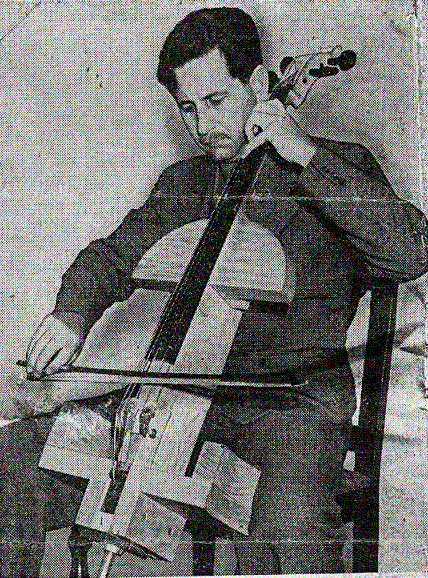
The gadget, called an electro-cello, was the latest of scientists' attempts to improve on the aged wood and fine Italian hand of the old violin makers. It was fashioned by Caltech's seismologist Dr. Hugo Benioff, who gave up violin playing as a boy because he couldn't stand the noise he made. Eighteen years ago, when he was designing seismographs to measure earthquakes, he decided that there wasn't much difference between a seismograph and a fiddle "except one deals with slow movements and the other with rapid movements." For his scientific cello he mounted a conventional fingerboard and electrified bridge on a heavy wooden frame and stood the whole thing on a metal peg leg. Instead of tones, Dr. Benioff's cello produces electrical impulses which are transmitted to loudspeakers. It has a wider range than a standard cello, but not the deep brown tone.
Cellists who are used to the old jokes about struggling into subways with their bulky instruments will find the electro-cello no better. It weighs 50 lbs. and requires enough amplifying equipment to load a small truck.
.
Los Angeles Times, Sunday July 7, 1946
Electro Cello Scheduled for Introduction
Hugo Benioff - California Institute of Technology, scientist, whose electrocello will be played by Stephen De'ak at his Bovard Auditorium, S.C., concert tomorrow night.
The first public performance of the new experimental "electro-cello" will be given by Stephen De'ak, University of Southern California School of Music faculty member, Monday night in Bovard Auditorium. He will be accompanied at the piano by Margaret Shanklin.
Considered as a new type of instrument with a more uniform timbre throughout, deeper and higher tones than those of the conventional cello, it was developed by Dr. Hugo Benioff of the California Institute of Technology after 18 years of research. "No sound is produced by the strings" explained the inventor "but vibrations actuate electrical current to produce the amplified tones."
.
1946 - Sound Transmitter and Receiver patent granted August 6 (2,405,185)
.
1946 - Piezoelectric Transducer patent granted August 6 (2,405,187)
...acoustic transmitting and listening appararus...
.
1946 - Ranging System patent granted September 17 (2,407,644)
A method of acoustic, supersonic and radio ranging which may be used in the field of submarine signaling for the determination of the distance of obstacles and reflecting surfaces...
.
Popular Science Monthly 1946, November (pg80)
Electric Cello Needs No Sound Box
Tiny crystals replace the traditional wooden sound box in a new electrical cello. A musician plays it in the usual way, but produces more sound with less effort - and over a wider tone range.
The vibration of the strings distorts crystals attached beneath. As these alternately expand and contract they produce a variable voltage current. Amplified, this is transformed into sound by loudspeakers.
The new instrument was invented by Dr. Hugo Benioff, California Institute of Technology seismologist. He says that both cellos and seismographs deal with vibrations - one type fast, the other slow.
[pic1] Current from electro-cello is divided into three frequency groups: 40-300, 300-3000, and 3000-14000 cycles. A separate loudspeaker turns each group into sound.
[pic2] Cantilvere aluminium bridge bends under string vibrations, transmits pressure to crystals.
[pic3] Dr. Benioff plays his invention. Heavily built of maple to confine vibration to strings, instrument weighs 25 pounds.
.
Electro-Piano patent filed February 13, 1959 - granted August 21, 1962
The invention will be described in connection with an electro-piano, it being understood that the principles of the invention may be applied to other stringed instruments, generally keyboard operated, in which in the past the vibrations of the strings have been transmitted to a sounding board by means of a bridge...

This work is licensed under a Creative Commons Attribution-NonCommercial-NoDerivs 2.5 License.
up